
Three years ago, I went to Andalusia in the south of Spain (for those who have long left their topographical knowledge behind in the classroom) for the first time with my cousin and her ex-partner. We landed in Málaga at the time, but unfortunately, that was all I got to see of the city, since we were staying two hours away in Granada. Not a punishment, of course. Absolutely not, but even then, I already thought: “Sh*t, I don’t want to miss Málaga.” But I still did…
Still, things happen for a reason, and this year I finally ended up in Málaga… Travelling in a company I never saw coming: my colleagues. In July of this year, I started a new job at a well-known training agency in the Netherlands. By October I was already invited to join the anniversary trip (best job ever or what?!). Nervous, of course, because how well do you really know your colleagues when you only have two office days a week? But there was nothing to worry about: it was an amazing holiday with wonderful company. So, in honour of this lovely trip to Spain, here’s a travel blog of my personal highlights of the journey. What is there to do in Málaga? And what is there to do in the surrounding area? I’ll tell you all about it now.
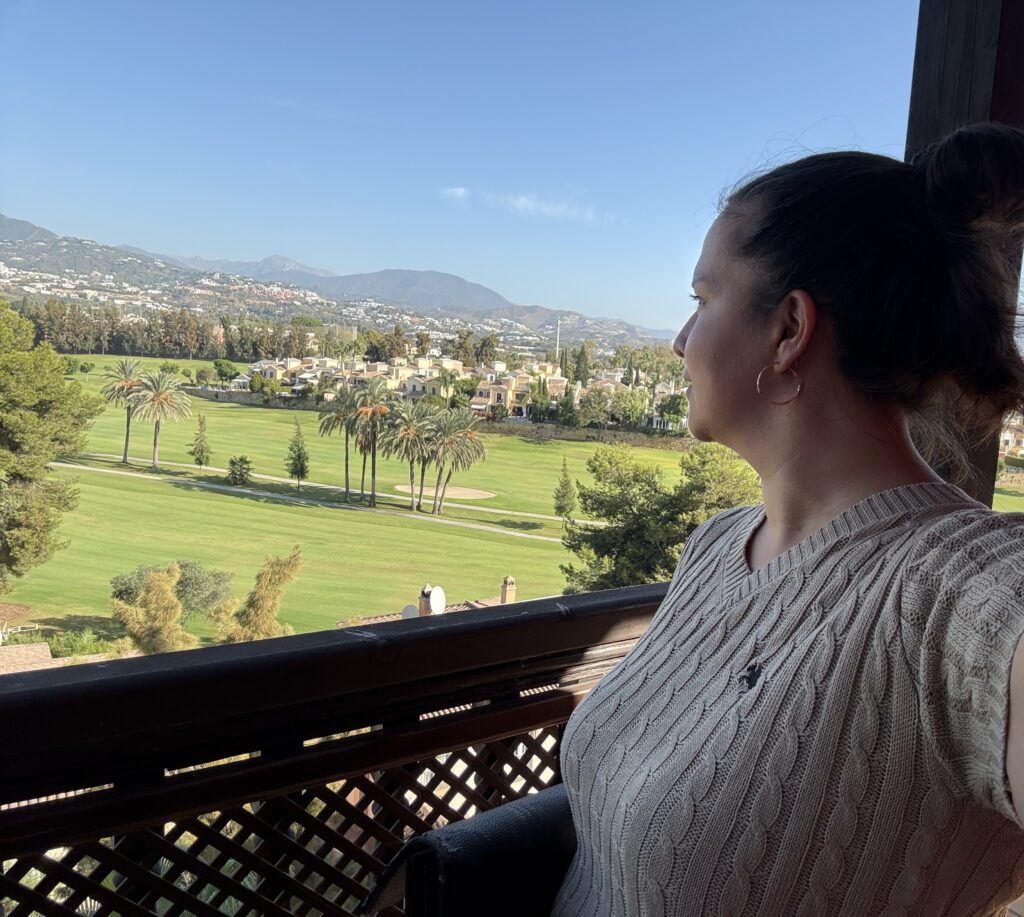
Everything that’s in this article
- 1 What to do in Málaga, Spain?
- 2 Romans in a Moorish fortress
- 3 The One-Armed Lady
- 4 Second Castle on the 130-Metre-High Gibralfaro Hill
- 5 Accidental discovery
- 6 Building with Mixed Feelings
- 7 Museum in a palace
- 8 Another Picasso city
- 9 Garden with a view
- 10 A place to relax
- 11 Centre Pompidou, but not in Paris
- 12 Foods and history
- 13 I’ll have a glass of wine instead
- 14 Semana Santa brotherhood
- 15 Fashion and cars
- 16 Money must be spent
- 17 Authentic Malaga
- 18 What to do in Málaga ? 6 tips
- 19 Popular attractions in Málaga region: 4 recommendations
- 20 So, what’s there to do in Malaga?
What to do in Málaga, Spain?
Now that I’ve spent a day in Málaga, I can tell you… it’s impossible to do in just one day! We saw and did a lot (even by bike to cover some distances), but we only scratched the surface of everything Málaga has to offer. Of course, everyone knows the famous (or infamous) bullfighting arena and Picasso’s birthplace. But the city’s harbour and the old town with its cathedral are also more than worth a visit. Moreover, on my next trip to this warm city, I would really love to see some things from the inside. I would love to visit the cathedral, the bank from La Casa de Papel, the Moorish fortresses… Really, I could go on and on.
But it’s not just what you can see that makes this city so special; it’s also the atmosphere. I come from a town in South Limburg where, after the shops close at six, you could hear a pin drop. Not in Málaga though… in fact, when we returned to the hotel after a delightful tapas tour around midnight, the shops, tapas bars, pubs, bodegas all were still open, and the city was buzzing with life. Fan-tas-tic! What an atmosphere!
Several colleagues of mine have emigrated to this part of Spain, and when I saw Málaga at night like that… man, I really do understand why. I’ve always said I wanted to live in London (or NYC if I marry a rich bloke or win the jackpot), but now I can definitely picture myself with a little house in southern Spain. Right, enough daydreaming for now. Why am I so enthusiastic about Málaga? Well, this is why: in my opinion, these are the 16 most beautiful highlights in Málaga. I’ll also share some fun things you can do in the city. Furthermore, I’ll highlight some awesome must-dos and must-sees in the Málaga region.
Romans in a Moorish fortress
If you wander around Málaga, it’s almost impossible to miss the mountain in the middle of the city’s old town. On this Gibralfaro Hill lies an ancient Moorish fortress: the Alcazaba of Málaga. The base of the fortress dates back to the ninth century. In the eleventh century, it was expanded further up the hill. You can not only explore the palace and marvel at the art and architecture, but also enjoy a magnificent view of the city and the thick city walls surrounding Gibralfaro Hill. Moreover, the archaeological museum is located within the fortress and is certainly worth a visit.
Did you know? Alongside the many Moorish influences, you can also find quite a few Roman traces in the Alcazaba. The ornate arches, figures, ponds with irrigation systems, and Arabic inscriptions are typically Moorish, but the Roman elements can be seen in the Roman columns. This is because the Moors used parts from the lower-lying Roman Theatre (Teatro Romano) to expand the fortress.
The One-Armed Lady
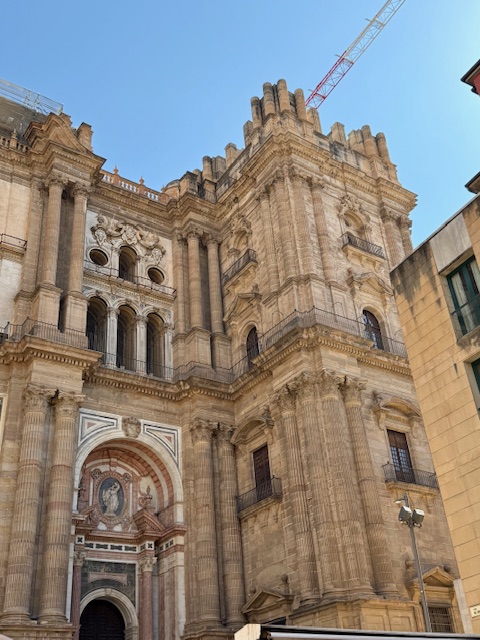
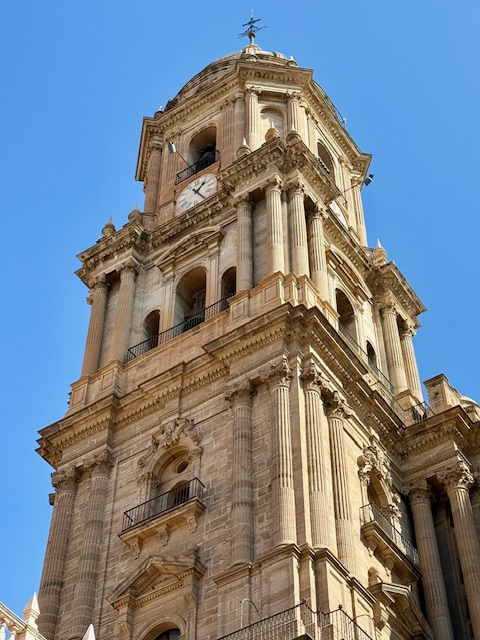
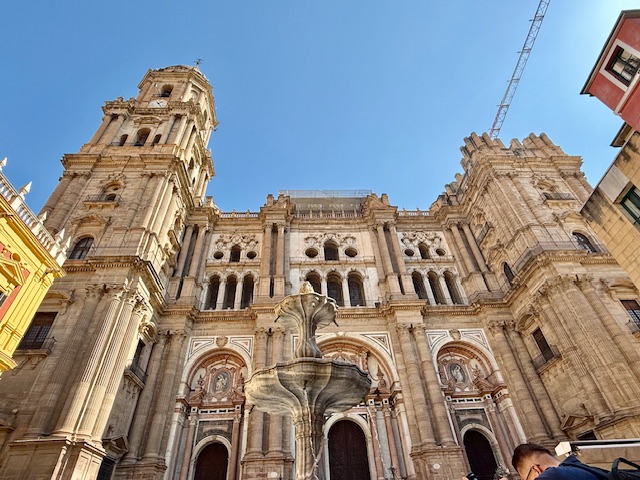
The One-Armed Lady, or La Manquita, is not a creature from the new Lord of the Rings films, but a nickname for Málaga’s cathedral. The cathedral owes this name to the single church tower that was completed. It stands on the Plaza del Obispo square, where you can also enjoy a drink or a bite to eat under the splendour of this majestic building. The full name of La Manquita is La Santa Iglesia Cathedral Basilica de la Encarnación. Construction of the cathedral began in 1528 and took no less than 200 years (and in that time, they only finished the 84-metre-high left tower, like really? How hard can it be?).
Did you know? Construction took so long because work was frequently halted due to a lack of funds. That’s also why the cathedral showcases three different styles: Gothic, Baroque, and Renaissance.
Second Castle on the 130-Metre-High Gibralfaro Hill
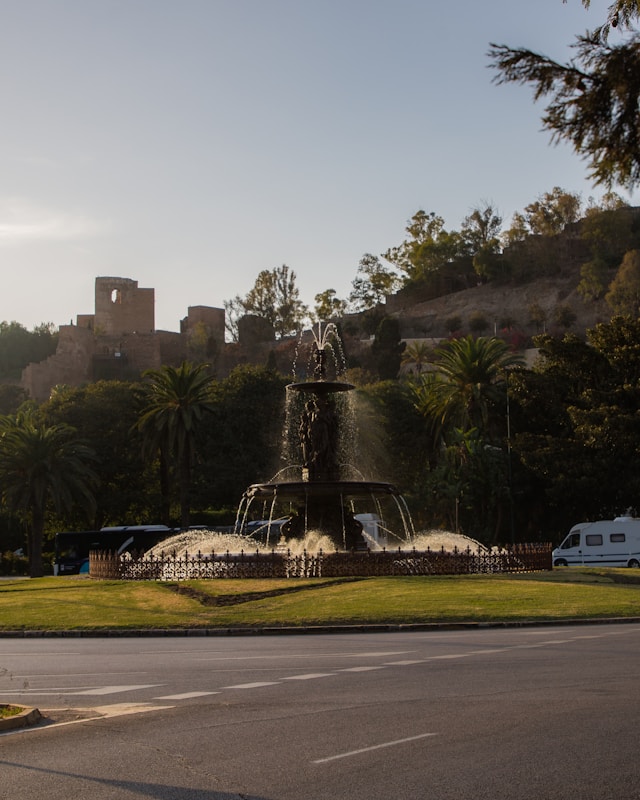
I just mentioned the Moorish fortress on Gibralfaro Hill, but there’s also a castle on that same hill (quite a busy place, isn’t it?). The Castillo de Gibralfaro dates from the 14th century and lies above the palaces and fortress of the Alcazaba. The castle was built by King Yusuf I of Granada to better defend the Alcazaba. The name “Gibralfaro” comes from the Arabic Jabal-Faruk, meaning “mountain of the lighthouse.”
You can also visit this castle, but beware: it’s quite a climb (around 20 to 30 minutes). However, you can take a bus (line 35) to the top of the hill. Within the castle walls, you can walk along the old defensive walls, climb the towers, and visit a small museum where you can learn more about Málaga’s military history.
Accidental discovery
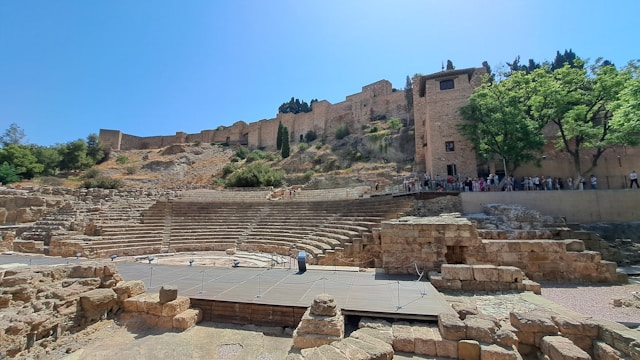
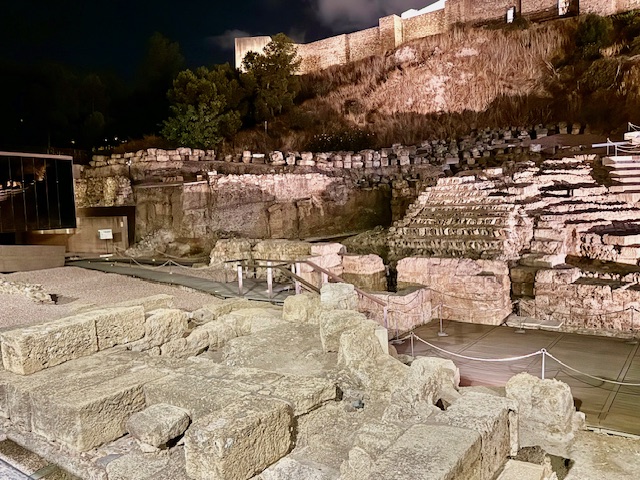
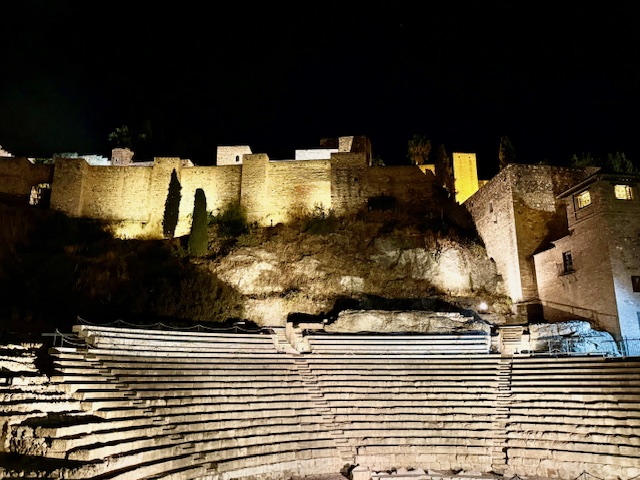
The Alcazaba was partly built using stone from the nearby Roman Theatre, but the ruins of this theatre can still be admired today. It dates back to the last century BC and can be visited free of charge. Situated against Gibralfaro Hill, it offers a beautiful view of the city walls and the Alcazaba.
Fun fact: The theatre was accidentally discovered in 1951 during excavations carried out for the construction of La Casa de la Cultura. In the late 1980s, the building was even completely demolished to continue the excavations. The restoration of the Roman Theatre then took almost thirty years to complete.
Until the third century AD, the Moors still used the theatre. Afterwards, parts of it were dismantled (to serve as building materials for the Alcazaba). Nevertheless, summer performances are still held in the theatre to this day.
Building with Mixed Feelings
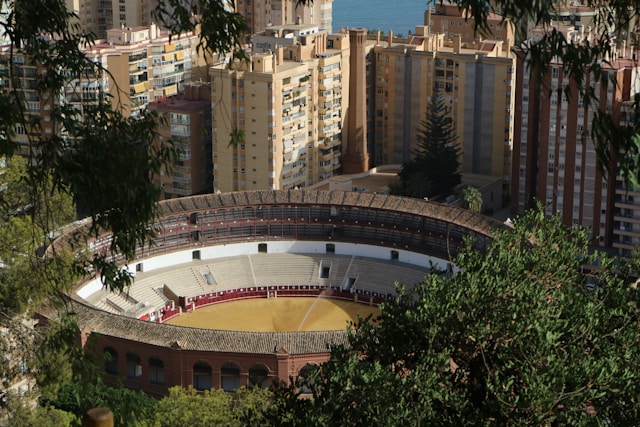
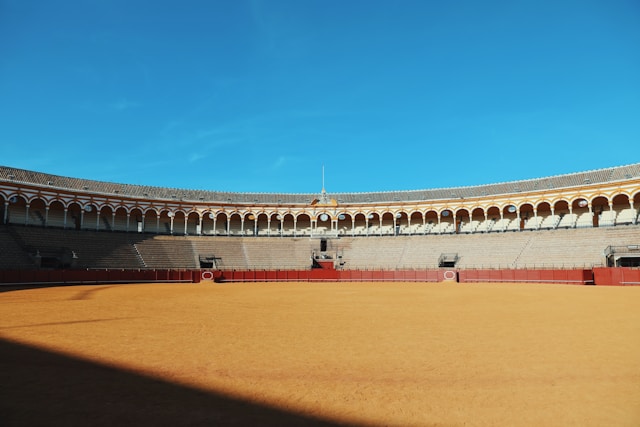
If I say Plaza de Toros, you probably already know what I’m about to talk about. La Malagueta is the arena where bullfights are still held today. This bull fight arena has a sixteen-sided shape and dates back to 1876. Inside, you’ll find a museum, the Museo Taurino Antonio Ordóñez, which tells the story of bullfighting.
The arena looks beautiful, but I can’t deny that I felt a bit sick there. Especially when our guide shared gruesome details with us, I felt closer to tears than laughter. I just can’t imagine that, in 2025, bullfighting is still a thing in Málaga. Normally, when you visit a historical site, you can imagine the horrors that took place there because they happened far in the past. Knowing that bulls and horses are still slaughtered here for human entertainment truly disgusts me (I mean, why not reopen the Colosseum for gladiator fights while we’re at it?). I suppose, as a tourist and outsider, I will never be able to understand the appeal of Matadors and Toreros. Fortunately, I might add. I neither need to nor want to understand it.
Museum in a palace
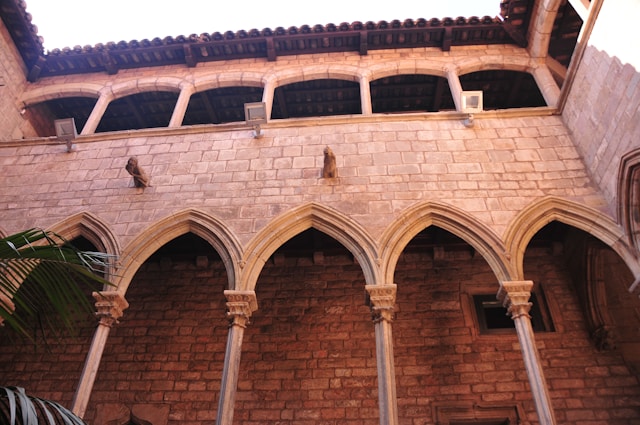
In the Palacio Buenavista lies the Picasso Museum of Málaga, actually very close to the former artist’s house. The museum in Málaga is fairly young and only opened its doors in 2003. In the museum you will mainly find Picasso’s earliest and latest works, consisting of sculptures, paintings and sketches. Although the works you find here do not fall under Picasso’s most famous pieces – for those you must turn to the museum in Paris or Barcelona – the museum is precisely because of this one of a kind and definitely recommended if you love art and are in Málaga.
Another Picasso city
And if you are already planning to visit the eccentric artist at the Picasso Museum, walk a little further to Plaza de la Merced, where the artist’s house is located. The house is also situated directly behind the statue of the artist on the actual square. The house has now become a small museum. Picasso first lived in the corner house, but later the Picasso family moved a bit further along within the same building. It is there that Picasso began painting.
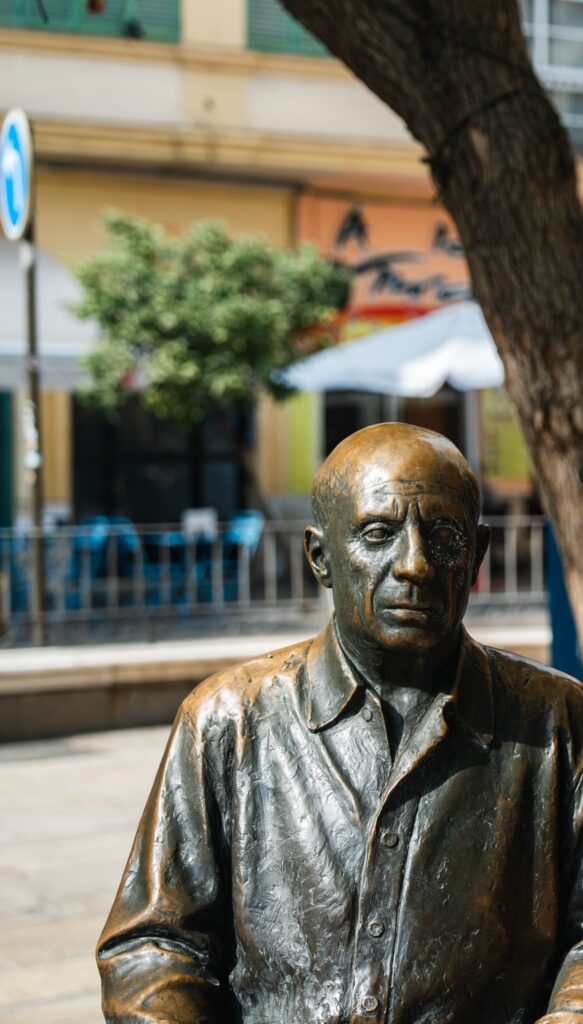
The bronze statue stands (or rather sits) on the square. The statue shows the artist seated on a marble bench, with a notebook and pencil in his hands. It is a popular attraction where visitors often sit down beside him for a photo.
Tip: Try stroking the statue’s head. According to superstition, men who do so will become wealthy. Women too… only wealthy in another way: with many healthy children.
Garden with a view
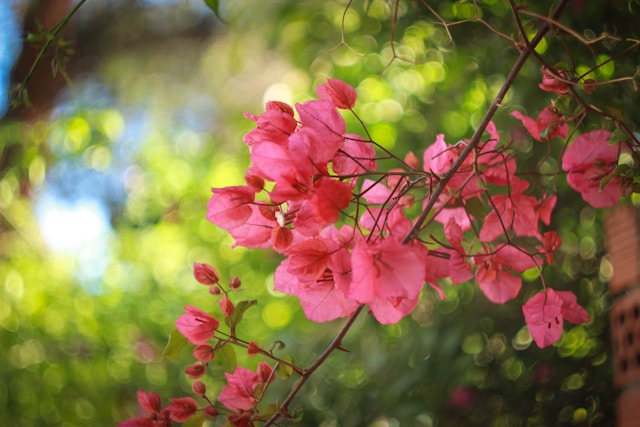
More than 150 years ago, the botanical garden of Malaga was founded. At first, the area mainly consisted of estates with olive, almond, and citrus trees. In 1855, the various estates were merged into one garden, and only in 1990 did the gardens come into the hands of the municipality of Malaga. From 1994 onwards, the gardens were opened to the public. By now, they are so large that you should set aside at least half a day to see most of it. There are several walking routes (including one through a bamboo forest) and also various beautiful viewpoints. You will find the gardens in the northern part of Malaga, close to the Montes de Málaga nature reserve.
A place to relax
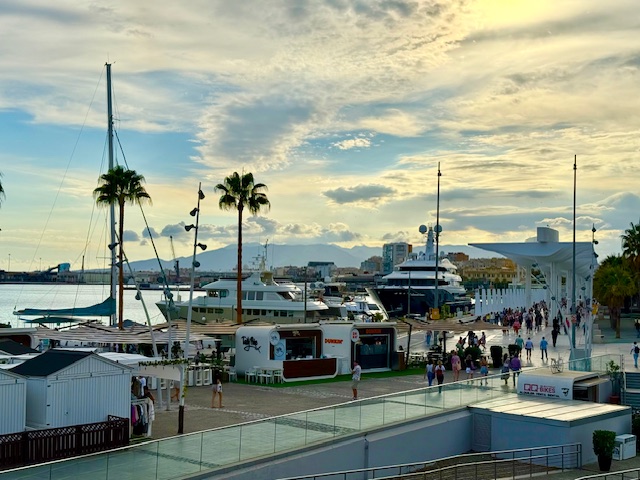
In the harbour of Malaga, you will find Muelle Uno: literally Pier 1. Around 2011, this boulevard was completely refurbished, and it has now become a true place to be. It is an open-air shopping centre with no fewer than 70 shops. You can enjoy a drink or a bite to eat at the many bars and restaurants.
Tip: There is even a 1-star restaurant, namely José Carlos García.
You can also simply take a seat on one of the many benches. With the palm trees providing shade above you, you can enjoy watching all the luxurious yachts moor here. You can also walk to the white lighthouse, because behind it lie the famous sandy beaches of Malaga.
Centre Pompidou, but not in Paris
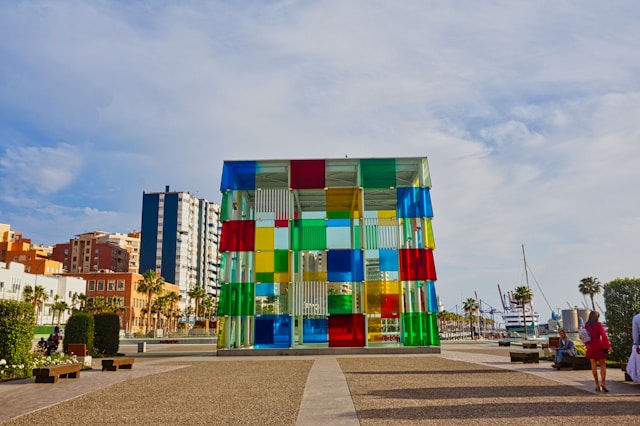
Behind Pier 1 stands a striking cube-shaped building with bright colours: the Centre Pompidou. “Huh? Isn’t that in Paris?” Yes, there too, but in Malaga you will find the first international branch. You can visit six different rooms to admire the permanent collection. In addition, the museum has extra spaces used for temporary exhibitions. All in all, it is a place where modern art truly comes into its own.
Foods and history
You find them everywhere: the famous covered food halls. Malaga also has one: the Mercado de Atarazanas. It is the largest market in the city and spans no less than 3 halls: one for meat, one for fish, and the last one for fruit and vegetables. And admittedly: you can smell the fish, so if it makes you queasy (and I wouldn’t blame you), it may be better to skip this sight. If you don’t mind the smell of fish, then definitely take a stroll through the halls. Sometimes, you can try things for free, but you can always sit down at one of the many tapas bars and enjoy some delicious bites.
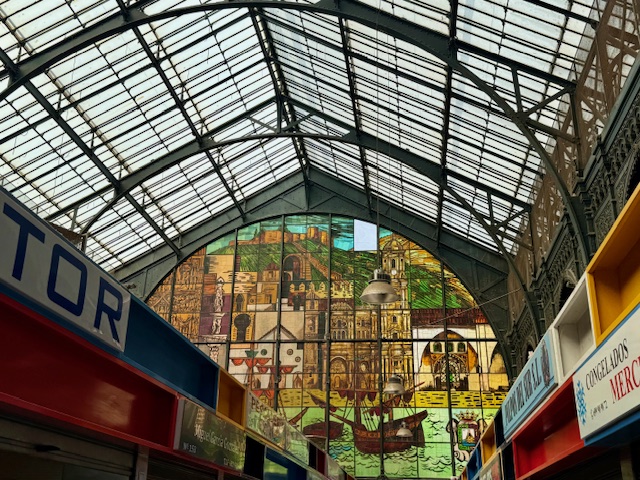
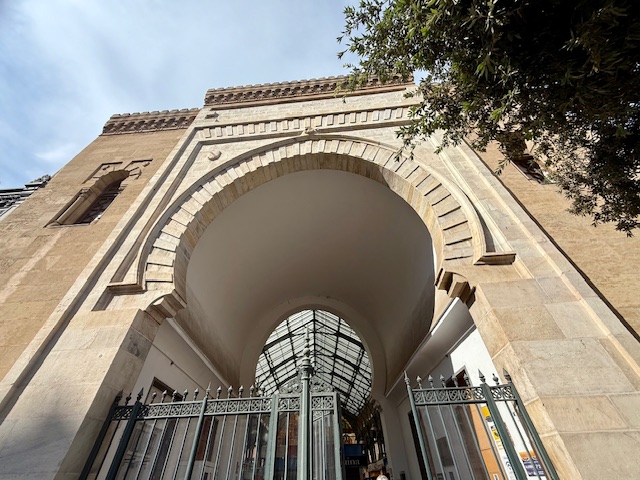
Not here for the food but more for the history? Even then, you can feast your eyes. The entrance to the market is a large Moorish gate that was once part of the city wall. The name Atarazanas is also historically significant: it is Moorish for shipyard. The market used to be the place where ships were repaired, since the waterline reached this part of the city wall in earlier times. Afterwards, the location was also used as military storage and as a hospital. The market as we know it today was built between 1876 and 1879.
I’ll have a glass of wine instead
In Malaga, you will also find a small but interesting wine museum. The wine museum is housed in a historic building known in Málaga as the 18th-century Palacio de Biedmas. Thanks to contributions from the province of Andalusia and the municipality of Málaga, the building has been fully restored. In the middle of the city centre, the museum offers a fascinating overview of the development and culture of the various wine types from the Malaga region.

Semana Santa brotherhood
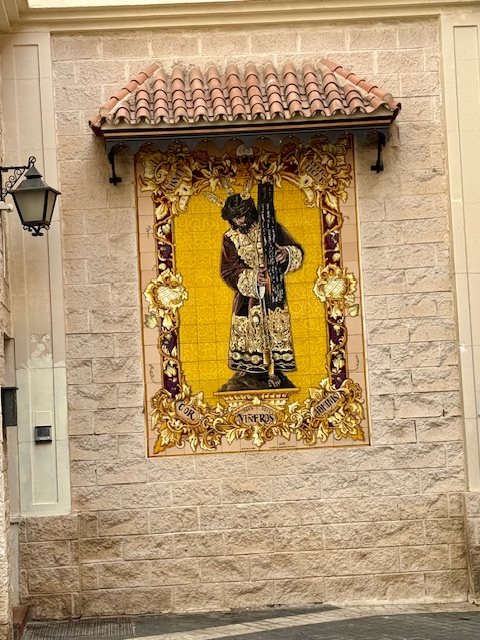
Opposite Malaga’s wine museum stands a remarkable building: it belongs to the Hermandad Sacramental de Viñeros. This is a religious brotherhood (one of many in Malaga) that is very well known because of Semana Santa.
Semana Santa: literally the Holy Week. This takes place in the week before Easter. During this week, impressive processions move through the streets, in which large, richly decorated statues of saints are carried by members of the brotherhoods. It is a combination of religious tradition, culture, and spectacle, and one of the most important annual events in many Spanish cities.
The Hermandad Sacramental de Viñeros is responsible for carrying one of the largest thrones with statues in Malaga.
Fashion and cars
In the Museo Automobilístico, you will find (surprise, surprise) a museum dedicated to automobiles. What you might not expect, however, is that you will also find plenty of information about fashion! A strange combination, I admit, but it works. Since 2010, the automobile museum has been housed in a side wing of the former Tabacalera factory from 1923. In this space, a modern museum style is combined with an impressive collection of 95 classic cars, originating from the private collection of the Portuguese textile entrepreneur Joao Magalhaes. Visitors can find iconic vintage cars from brands such as Hispano Suiza, Rolls-Royce, Mercedes-Benz, Bentley, and Ferrari. One of the museum’s rooms is dedicated to 20th-century fashion, including an extensive collection of hats from the 1920s to the 1950s.

Money must be spent
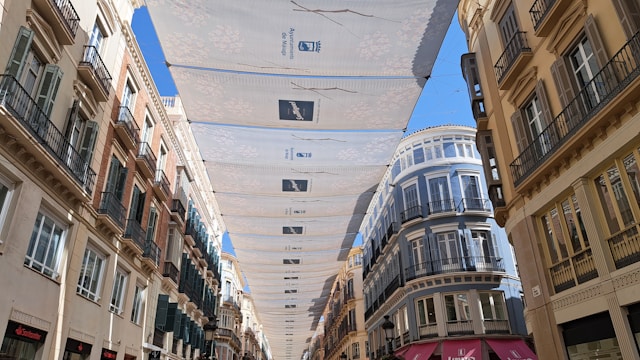
“All very nice, all that culture. But I just want to shop for some goods!” Malaga also has the perfect place for shopping enthusiasts: Calle Marqués de Larios. It is the most famous and expensive street in Malaga, but it is completely car-free and exudes peace and elegance. In summer, you can shop in the shade, because large white cloths are stretched across the street to block the sun.
Tip: And do you need extra cooling? Calle Marqués de Larios is also home to the ice-cream parlour that the locals consider the best in town.
Authentic Malaga
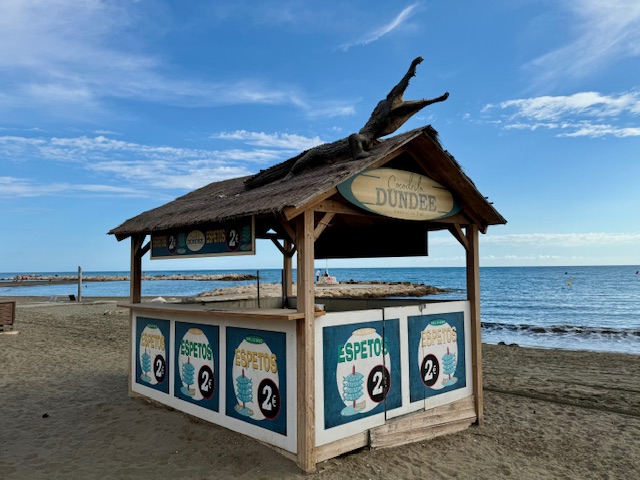
If you follow Malaga’s coastline from the city centre towards the east, you will arrive in the fishing village of Pedregalejo. This is where the locals go to the beach and enjoy a drink on the quiet boulevard. It is not very touristy, but that is precisely what makes the place so charming. Along the boulevard you will find numerous (traditional) fish restaurants. Around dinnertime, the air fills with the scent of burning wood, coming from the sand-filled boats on the beach that serve as barbecues. The grilled sardines, the well-known espetos de sardinas, are especially popular. If you are looking for a truly authentic experience, Pedregalejo is definitely the place to be.
What to do in Málaga ? 6 tips
So far I have mainly talked about things you can see and visit in the city of Málaga . However, there are also plenty of things to do. I will give you 6 tips:
- Cycling: How Dutch can you get, right? But I must admit that when we cycled comfortably through Málaga for work, a cycling tour really was a great way to explore the city.
- Rooftop terrace: How New Yorkish can you get? Málaga may not have real skyscrapers like New York or London, but here too you can enjoy the view from a rooftop terrace. Recommended spots are H10 or San Juan.
- Beach: With all the beautiful things there are to see, you might forget it, but you can easily plan a beach day in Málaga as well. In Málaga itself there are very touristy beaches, but if you go a bit further (by bike, for example), you will find quieter beaches where the locals spend their time.
- Flamenco: If you are in Andalusia, you really should catch a flamenco show somewhere. We did one in Marbella, but Málaga also has several well-known shows, such as Flamenco Alegría.
- Pimpi: A bodega in Málaga where you can enjoy wines and local gastronomy.
- Casa de Guardia: And if you are already in the tapas vibe, then be sure to try the oldest bodega in Málaga as well.
Popular attractions in Málaga region: 4 recommendations
The Málaga region offers a wide range of tourist attractions, combining beaches, cities, historic sites and natural areas. Along the Costa del Sol, popular seaside towns such as Torremolinos, Benalmádena and Nerja attract visitors with sandy beaches, promenades, beach restaurants and clear water. Nerja is also known for the Nerja Caves, a large cave system with impressive stalactites and underground chambers that can be visited year-round.
My visit to this region was too short; there’s still a lot to see I imagine, but these were personal favourites of mine:
1. Caminito del Rey
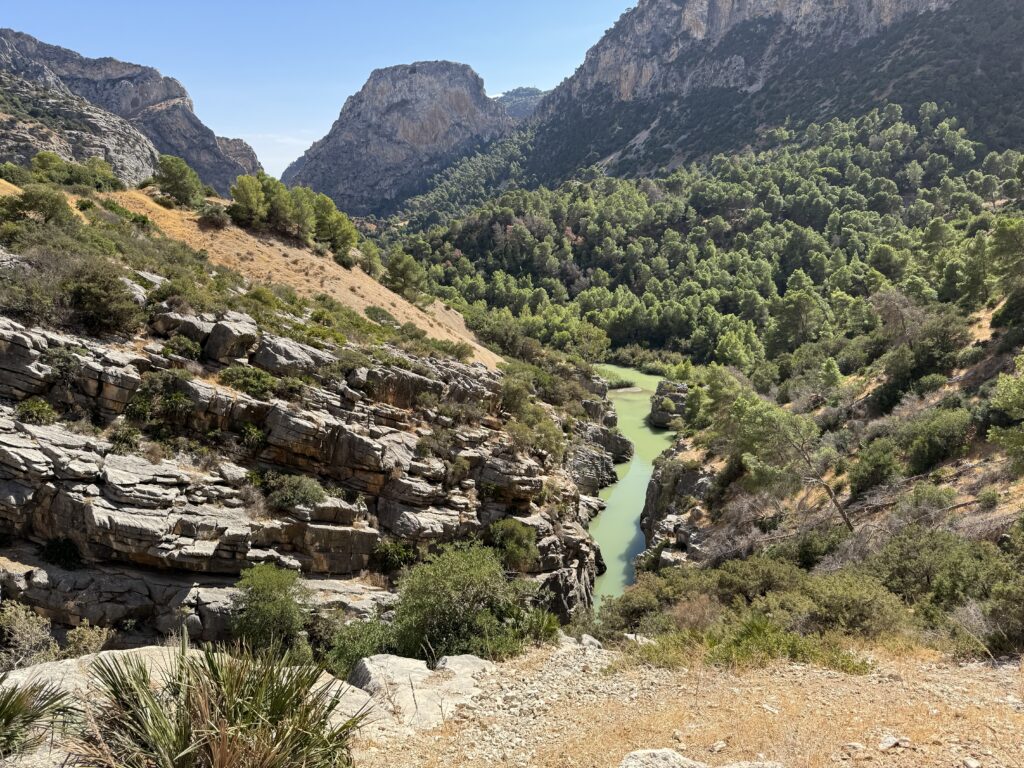
El Caminito del Rey is one of the most popular outdoor attractions in the Málaga region. It is a walking path built along the walls of the mountains: Gaitanes Gorge (about an hour’s drive from Málaga city). The route follows a narrow boardwalk attached to the rock face, with the river far below, offering clear views of the surrounding landscape throughout the walk.
The hike is around eight kilometres long and takes three to four hours to complete at a relaxed pace. It is well maintained and considered safe, with railings, helmets provided for visitors and controlled entry numbers. While some sections are high and may feel challenging for those with a fear of heights, the route is suitable for most people with a reasonable level of fitness.
Along the way, visitors can see dramatic cliffs, bridges, and sections of the original early twentieth-century walkway that once gave the path its dangerous reputation.
2. Marbella
Marbella is one of the best-known destinations on the Costa del Sol. The town is known for its beaches and beach clubs, promenades and water sports, making it suitable for relaxed beach days as well as more active holidays. The historic Old Town, known as Casco Antiguo, provides a contrast to the modern areas. It features narrow streets, whitewashed buildings and small squares, including the well-known Plaza de los Naranjos. Here, visitors can find local shops, cafés and traditional restaurants.
The Old Town is a pleasant area to explore on foot and gives a sense of Marbella’s history and Andalusian character.
Marbella is also associated with luxury and nightlife, particularly around Puerto Banús. This marina is known for its yachts, designer shops and lively bars and clubs. We’ve been to a flamenco show in Marbella at the Tablao Flamenco. We ate there, after which we were able to enjoy a wonderful show featuring a mother, daughter and grandmother Gitana.
3. San Pedro
San Pedro de Alcántara is a quieter and more traditional town located just west of Marbella. We ate there at a beach club the first night in Málaga . The town has a relaxed atmosphere and is well suited to families, with wide streets, parks and a long, clean beachfront. The seafront promenade is one of San Pedro’s main attractions. It is ideal for walking or cycling and is lined with beach restaurants where fresh fish and local dishes are served. The beaches here are generally less crowded than those in central Marbella, making them popular with both locals and visitors looking for a calmer setting.
4. Paella workshop in Ojen
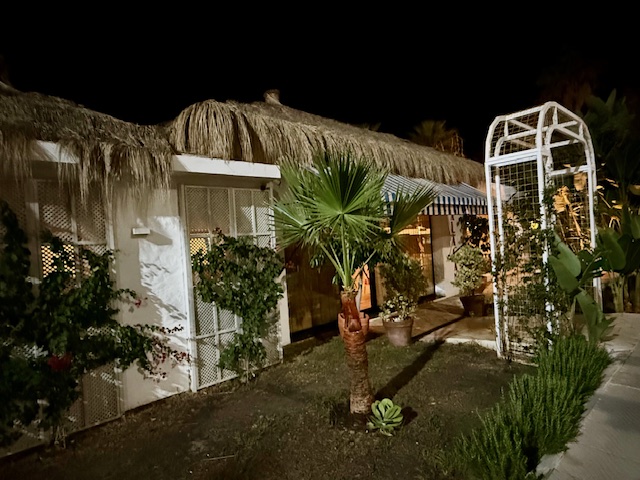
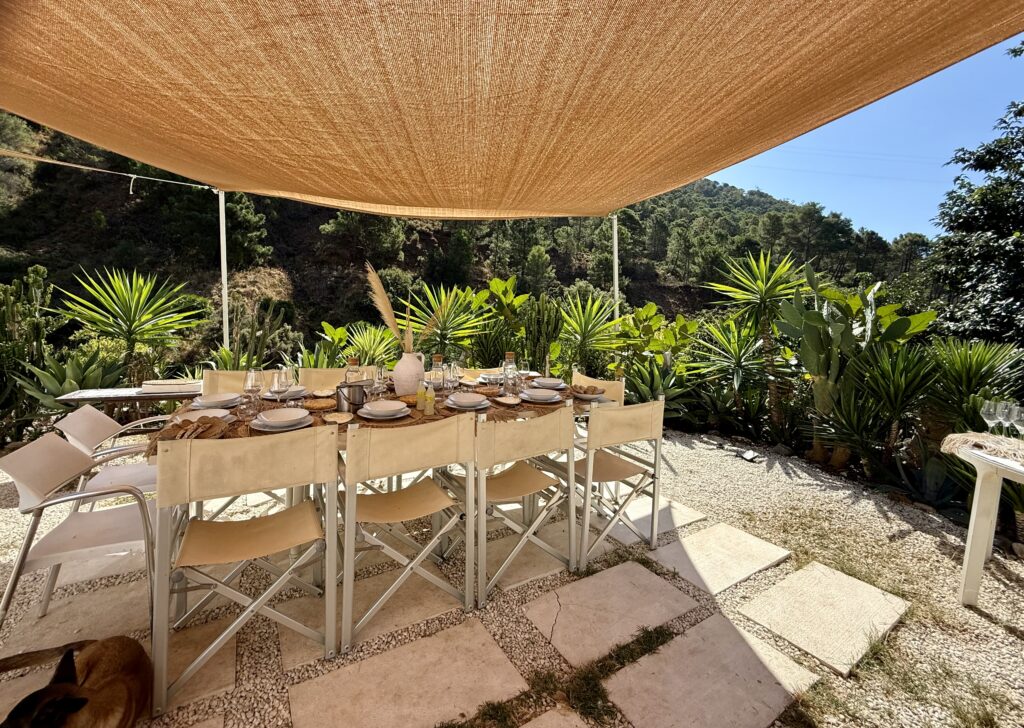
On our second day in Málaga, we drove along narrow mountain roads to a paella workshop set in the mountains, just outside the small village of Ojén. It was a phenomenal experience; the owner could hardly have lived in a more rural setting. Surrounded by mountain peaks, you almost forgot to pay attention to how the paella was being made. However, it was so interesting to see how traditional seafood paella is prepared that you were quickly drawn into the story behind the dish. The best part, of course, came at the end: enjoying the paella while taking in the impressive mountain views around us.
Note: If you get travel sick easily, it is better to take a workshop in a less traditional location. I became quite nauseous due to the twisting mountain roads, and I can usually handle a fair amount.
So, what’s there to do in Malaga?
All in all, Málaga is a city that surprises at every corner, blending history, art, gastronomy, and a lively atmosphere into one unforgettable experience. From the ancient walls of Alcazaba to the modern art of the Pompidou, from bustling tapas bars to the serene beaches of Pedregalejo, there’s something to capture every traveller’s heart. My short visit definitely left me wishing for more. So whether you’re wandering alone, with friends, or family (or with new colleagues as it turned out), Málaga has a way of giving you the perfect taste of Andalusia.
Natasja Bartholomé,
author & travel blogger
Last fun Fact: I have a holiday song for every holiday. Would you like to know which ones? Then listen to my special Malaga playlist on Spotify.